March 30, 1987. The Christie’s auction house in London was buzzing. A Van Gogh “Sunflowers” had just come up for sale.
The date was no accident. It was Van Gogh’s birthday, and Christie’s had timed the sale on purpose. The painting belonged to the Chester Beatty family, British mining magnates, and it was one of only six “Sunflowers” in existence.
The estimate had been around 10 million pounds. The auction lasted four minutes. Phone bidders fought it out, and the hammer fell at 24.75 million pounds, about 39.9 million dollars. It nearly quadrupled the previous record for a work of art at auction, Mantegna’s “Adoration of the Magi,” which had sold for 10.4 million dollars. It was, at the time, the highest price ever paid for a painting.
The buyer was a Japanese company, Yasuda Fire and Marine Insurance, known today as Sompo Japan. Forty million dollars for a single painting was an unthinkable number back then, and it turned the art market upside down overnight.
Van Gogh originally painted seven sunflower still lifes. He made four originals in Arles in August 1888. Then, in January 1889, he painted three more versions based on two of the originals, bringing the total to seven. One of the three flower version stays in a private collection and has never been shown publicly. Another was bought by a Japanese businessman, Yamamoto Koyata, in the 1920s, and was destroyed in a US air raid in August 1945.
Six paintings survive today. Setting aside the one in private hands, five are on public display: at the National Gallery in London, the Neue Pinakothek in Munich, the Van Gogh Museum in Amsterdam, the Philadelphia Museum of Art, and the Sompo Museum of Art in Tokyo.
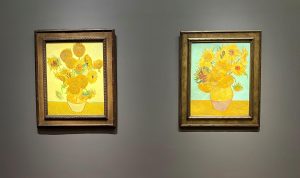
These paintings are scattered across the world, and the chance to see two of them side by side is rare. This summer, the most prized of them all, the London National Gallery’s Sunflowers, crossed the ocean to Philadelphia. I went to see both.
What Is the Most Expensive Sunflower Worth?
Of the seven, the two most celebrated are the London and Munich versions. Van Gogh considered these the best of the four originals he painted in Arles in August 1888, and he was the only one he signed.
The London painting has a particular history. It’s the one Van Gogh hung in Paul Gauguin’s room. If you had to name the single most valuable flower painting in the world, this might be it.
Seeing the London Sunflowers again in my forties, I felt something I hadn’t as a twenty something visitor. The light coming off the canvas had a presence, an aura that photographs never capture. And I never noticed before that this painting is almost entirely yellow, close to 99 percent of it. If Monet was the master of light, Van Gogh was the magician of color.
That’s enough admiring for now. Let’s talk about what these two paintings might actually be worth.
The current auction record for any painting belongs to “Salvator Mundi,” attributed to Leonardo da Vinci. It sold at Christie’s New York in 2017 for 450.3 million dollars. The price reflected both the rarity of a Da Vinci on the market and a bidding war among the world’s wealthiest collectors.
Art auctions place an extreme premium on an artist’s defining work, especially a “first” or most iconic piece. Salvator Mundi commanded such a price because a single, globally recognized painting attracts sovereign wealth fund level money, regardless of what art historians think of it. If the London Sunflowers ever came up for sale, it would very likely break the record for any painting ever sold, and could easily clear 500 million dollars.
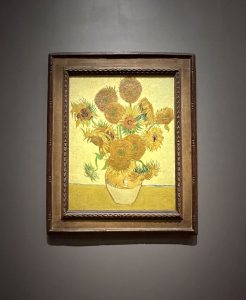 The current auction record for a Van Gogh is “Orchard with Cypresses,” which sold for 117.2 million dollars in the 2022 Paul Allen collection sale. Few people outside the art world know that painting. The London Sunflowers is different. Most people who have never heard of Van Gogh have still seen this image somewhere, and it’s one of the original four from August 1888. Given the premium the market pays for “the first,” I’d estimate this painting’s value somewhere between 400 and 600 million dollars, comfortably above the Salvator Mundi record.
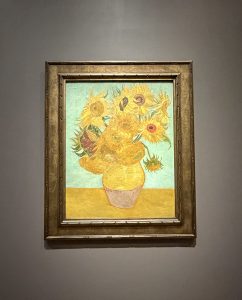
For the Philadelphia Sunflowers, I’d estimate 300 to 400 million dollars. My basis is the 39.9 million dollars Yasuda paid for the Tokyo Sunflowers in 1987. Apply the long run 5 to 6 percent annual return that blue chip art is often said to generate, compounded over 39 years, and you land somewhere around 270 to 390 million dollars.
Add the two together and you get roughly 700 million to 1 billion dollars for the paintings I saw that day. I really did spend an afternoon looking at a billion dollars worth of sunflowers.
I should say clearly that none of this is a real appraisal. It’s napkin math built on a single data point from nearly forty years ago, and neither painting will ever actually go to auction. The National Gallery is legally barred from selling its collection, and the Philadelphia painting comes with bequest restrictions of its own. These paintings have become, in a real sense, priceless: not because of some abstract sentiment, but because money literally cannot buy them.
If you’d still like to see a Van Gogh Sunflowers that a check once actually paid for, the Yasuda purchase means there’s one within reach of Korea, at the Sompo Museum of Art next to Sompo Japan’s headquarters in Shinjuku, Tokyo, an easy walk from Shinjuku Station.
Sunflowers of Waiting and of Loss
In February 1888, worn out by life in Paris, Van Gogh moved south to Arles. He dreamed of building a community of artists there. He idolized Paul Gauguin, and he convinced his brother Theo to fund Gauguin’s living expenses so Gauguin would agree to join him. Gauguin, buried in debt, accepted for financial reasons more than artistic kinship.
 Van Gogh spent that whole summer preparing for Gauguin’s arrival. He rented the Yellow House on the Place Lamartine, set up two beds, and in August began the sunflower paintings meant to decorate Gauguin’s room. In a letter to Theo from that time, he wrote that he was painting sunflowers the way a man from Marseille eats bouillabaisse, and that he was planning a set of a dozen canvases.
For Van Gogh, sunflowers stood for the sun of Provence, for gratitude, and for the friendship he was offering Gauguin. Since the flowers would wilt before he could finish, he painted four canvases in a single week. The London National Gallery painting is one of them.
Gauguin arrived in October. He admired the sunflower paintings, and even painted a portrait of Van Gogh at work on one. That portrait became a problem. Van Gogh said the man in it looked like a lunatic.
The two men were opposites in temperament and in their approach to art. Van Gogh painted in a fever, straight from nature in front of him. Gauguin worked from memory and imagination. Van Gogh craved validation and pushed for it in nightly arguments, and Gauguin found it harder and harder to bear. In December, Gauguin wrote to Theo that he and Vincent simply couldn’t live together.
On the night of December 23, when Gauguin made clear he intended to leave, Van Gogh spiraled into an extreme state of distress. What exactly happened that night still isn’t fully known, but he cut off part of his own left ear. Gauguin left for Paris.
The following January, once he was out of the hospital, the first thing Van Gogh did was paint sunflowers again, this time copying his own originals. Those repeated versions are the ones now in Amsterdam and Philadelphia.
If the London painting is a sunflower of hope and anticipation, the Philadelphia one is a sunflower painted by a man trying to reclaim hope after everything had fallen apart. Standing in the Philadelphia Museum, you can see both at once: the eager longing for a friend still on his way, and the grief of a friend already lost.
There’s a bitter irony to what came after. Once the friendship had collapsed, Gauguin wrote asking Van Gogh for one of the sunflower paintings. Van Gogh refused. He wrote back with four words: the sunflowers are mine.
Taking a Child to See a Masterpiece
Honestly, the real reason I bothered to work out what these paintings might be worth wasn’t just curiosity.
My child, who’s in elementary school, has zero interest in art. To a kid that age, paintings and sculptures in a museum are just boring scenery. But kids these days do love money.
Ask, “Do you know how much the most expensive Van Gogh painting is worth?” and suddenly you have their full attention.
Tell them, “There’s a sunflower painting hanging in the Philadelphia Museum right now worth about a billion dollars, and this is a rare chance to see it,” and they’re happy to go look.
An elementary schooler obviously can’t grasp the sadness woven into that painting’s history. Still, I want them to encounter it early. Call it a parent’s small, stubborn attempt to pass down a bit of cultural capital.
That’s how, framed around a wildly expensive sunflower painting, I managed to get my child in front of several other Van Gogh works too, including “The Starry Night.”
Right now, my child will probably just remember it as the expensive flower painting. But someday, when they’re older, when they’ve waited desperately for someone or had to say goodbye to someone they loved, I think they’ll understand these two sunflowers differently: one painted while waiting, one painted after loss, and both, somehow, still standing.
Originally written by Zen for LifeMoney. English translation/adaptation assisted by Claude.