 Some people have plenty of money but rarely travel. Others aren’t wealthy at all, yet seem to be on a plane every other month. So why would travel be a meaningful measure of wealth at all?
Because wealth isn’t simply “having a lot of money.” There’s a subtle but important difference between being rich and being wealthy. Wealthy implies more than abundant assets. It implies a kind of ease: ease of mind, ease of time, ease of space. It’s less about the size of your bank account and more about how much room you have to breathe.
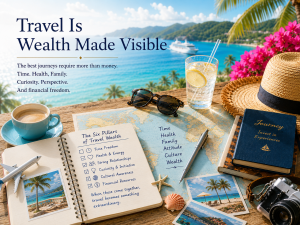
The Six-Sided Scorecard Behind Every Trip
Consider what it actually takes to pull off a real trip with your family: a long-haul flight, five or six days away, sometimes two weeks.
First, time. You need days you can simply give away. Even a CEO or senior executive can’t take a long trip if there’s no one to cover for them. In Korea, the generation that built the country’s postwar wealth, people now in their 60s and 70s, rarely traveled much at all. They worked relentlessly and accumulated real wealth, but never had the time, or the permission in their own minds, to step away. Many Korean companies still run on that same logic. Plenty of employees forfeit unused vacation days rather than take them, and there are still managers in their 40s who’d rather be paid out for unused leave than actually use it. The cash value of a vacation day, for them, outweighs the vacation itself.
Second, physical health. Hiking the trails of the Grand Canyon, ziplining through a Costa Rican jungle, snorkeling off Cancún: none of that works if your body can’t keep up. Real travel today often means more than walking around and taking photos; it means swimming, trekking, kayaking, paddleboarding. That requires a baseline of fitness that has to be built well before the trip itself.
Third, a family that actually wants to be together. This is the one thing money can’t buy outright. Most travel happens with family, and a family trip is only as good as the relationships behind it. Someone who’s spent years buried in work, distant from their spouse and kids, won’t suddenly enjoy a vacation just because they finally have the time for one. This matters most when children are still young, in elementary school, or just entering the turbulence of adolescence. A parent who skips that window often finds, years later, that the kids no longer want to travel with them at all. The simple fact that a family can travel together, and wants to, is itself a form of wealth.
Fourth, the energy to actually plan it. Even someone with time, health, and a loving family will go nowhere if they’re not willing to put in the work. A trip that’s rich, relaxed, and well-paced doesn’t happen by accident. It takes research: comparing airlines, vetting hotels, buying travel insurance, booking activities. A prepackaged tour is easy, but building something tailored to your own family takes real effort. That effort, in a sense, is a proxy for something larger: an active, engaged relationship with your own life.
Fifth, what sociologists call habitus, or cultural fluency. Travel rewards what you already know. The Rosetta Stone at the British Museum or the Temple of Dendur at the Met will strike you either way, but knowing the history behind them changes the experience entirely. Museums, galleries, and historic sites around the world are repositories of human memory. The cultural literacy you bring with you is often what turns a good trip into an unforgettable one, and it’s the one asset on this list that can’t be bought on short notice. It has to be built over a lifetime of curiosity.
And finally, of course, money. On a long flight, business class is simply more comfortable than economy. A five-star resort is a different experience than a budget motel. The more developed a country’s tourism infrastructure (premium cabins, hotel tiers, private guides), the wider the gap between what a small budget buys and what a large one does. Comfort and depth both, in the end, cost something.
Someone who has all six of these, and travels often as a result, is wealthy in the fullest sense: not just financially, but in spirit and in happiness. Travel becomes a mirror for wealth itself, reflecting not just net worth but health, time, relationships, and a person’s whole orientation toward life.
Call it the hexagon of wealth.
The Rise of a New Kind of Rich
Korea’s industrializing generation, those now in their 60s and 70s who built fortunes from nothing, undeniably had money. They built up real estate and financial assets, and spared no expense on their children’s education. But travel was where they pulled back. Vacation days went unused. They worked compulsively, almost like ants building a colony. A long trip felt like an indulgence they couldn’t justify.
This wasn’t because they were lazy or didn’t love their families. For that generation, wealth was proven through assets, not experiences. Saving was the virtue; spending was the vice. Working was noble; leisure was wasted time. Travel was a cost with no return, tiring, and not even particularly fun.
But a new generation has quietly taken its place.
Hana Financial Group’s 2026 Wealth Report coined a term for it: “K-Emilli,” newly wealthy Koreans, typically under 50, who crossed into the ranks of the affluent within the last decade. The average age is 51; 30% came from ordinary salaried or government jobs rather than business ownership. Average total assets run around 6 billion won (roughly $4.3 million), with average household income near 500 million won (about $360,000) a year.
Asked where they spend most freely, this group put travel at the top: 29%, nearly three times the runner-up, hobbies, at 10%. For Korea’s newly wealthy fifty-somethings, travel is where the wallet opens widest.
In the same survey, K-Emilli ranked “freedom of time” above material display as their core definition of wealth. Having money but no time, in their view, simply doesn’t count as being rich.
This new cohort has reopened the entire question of what “rich” even means in Korea: the freedom to go for a run by the Han River on a weekday afternoon, a CEO who takes two weeks off to travel with family. It’s a sharp departure from a generation that worked around the clock and measured success in foreign cars and luxury logos.
America’s Top 10%: Six Trips a Year, on Average
In the United States, the pattern is even starker: the more a household earns, the more it travels.
According to Resonance Consultancy’s 2026 Future of Luxury Travel report, America’s top 10% of households, earning between $240,000 and $600,000 a year, are projected to spend a staggering $544 billion on leisure travel this year alone.
The top 1% spend roughly $12,400 per trip and take six trips a year, adding up to about $74,400 annually on travel alone. Within that top 1%, the share taking six to eleven trips a year climbed to 27% in 2025.
The top 10% as a whole spend about $7,900 per trip, averaging 4.3 trips a year.
For context, the average American traveler takes just 2.8 trips a year, spending about $3,700 per trip.
A separate 2025 Forbes Research survey of the “mass affluent,” those with $200,000 to $2 million in investable assets, found that 59% ranked travel among their top three symbols of success, ahead of luxury cars at 31%. Among those with $1 million or more in investable assets, that number rose to 75%.
It’s worth noting that even in America, the older generation of the ultra-wealthy didn’t always travel this way. Warren Buffett, now 95, built one of history’s great fortunes but has lived famously frugally his entire life, with little public record of spending on travel or leisure.
From Owning Things to Having Experiences
I remember a moment at the Grand Canyon. Two American boys were wearing their Junior Ranger vests, covered edge to edge in park badges: Yellowstone, Zion, Yosemite, Rocky Mountain, Arches, Grand Teton. Their parents, it was clear, had been taking these ten-year-olds on a mission across the entire National Park System, one park at a time.
In the U.S., a typical middle-class family visiting a national park will plan five or six unhurried days around it. Compare that to a typical Korean package tour: fly into Las Vegas, see the Grand Canyon in a single overnight trip, or in the most extreme itineraries, somehow cram in the Grand Canyon, Horseshoe Bend, and Antelope Canyon all in one day.
Korea’s new wealthy class is moving away from that kind of compressed, transactional travel.
These days, draping yourself in foreign cars, designer bags, and stacks of jewelry doesn’t quite read as classy wealth anymore. Once you actually have money, it doesn’t take long to realize that owning ten watches or driving a Porsche doesn’t mean much beyond the first one.
Things become familiar fast, and anyone with enough cash can buy them. Experiences become memories.
Ten luxury watches don’t shine the way a Greek island cruise does, or an Antarctic expedition, an African safari, a tour through America’s national parks, because those become the stories you tell, the memories you share with the people you love.
Of course, plenty of people still dream of owning an apartment in Gangnam, Seoul’s most coveted neighborhood. But if you take out a massive loan to buy that apartment, and the debt keeps you from ever having real time with your family, can you really call that wealthy?
In the past, what mattered was how much you owned. Now, what matters is whether you can be with the people you want, whenever and wherever you choose. We may be in the middle of a shift: from Rolex, Hermès, and Gangnam real estate toward time, freedom, health, travel, and wellness; from material consumption to experiential consumption.
Travel is the clearest signal of that shift. It’s a form of spending, yes, but not just spending.
It’s the place where someone’s time, health, relationships, cultural depth, and financial freedom all show up at once. A complete report card on what wealth actually means.
Sources: Hana Financial Group, 2026 Korea Wealth Report; Resonance Consultancy, 2026 Future of Luxury Travel; Forbes Research, 2025 Mass Affluent Survey