Miri Capital Management LLC is a name most Korean investors have yet to encounter. That changed last year when the Boston-based firm secured a controlling stake in STIC Investments, one of Korea’s most storied private equity houses, announcing its presence in the market with unmistakable force.
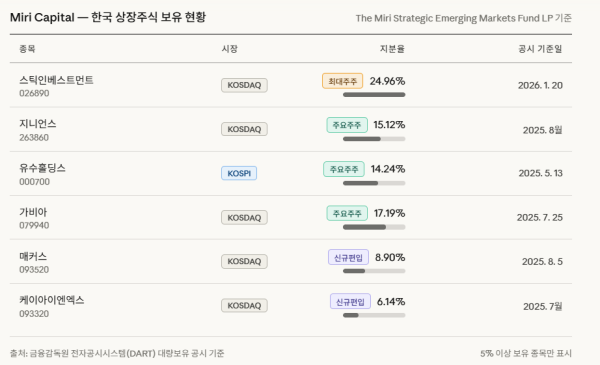
Why would an American investment firm travel this far — figuratively and literally — to accumulate stakes in Korean small-cap companies? What makes the story more intriguing is that Miri Capital’s investment philosophy bears a striking resemblance to the approach being championed by domestic value investors like VIP Asset Management, even though the two firms have no known connection. The simultaneous arrival of foreign activist capital and homegrown value-activist capital, both targeting the same pool of low-PBR Korean companies, suggests that the seeds of a quiet revolution in Korean equities may already have been planted.
What Is Miri Capital?
Miri Capital is a boutique investment manager founded in 2020, headquartered in Boston, Massachusetts, with additional offices in Tacoma and Portland. The firm employs roughly nine people — a deliberately lean operation by any standard.
According to SEC filings, Miri Capital manages approximately $495 million in assets under discretionary management as of early 2025, equivalent to roughly 700 billion Korean won.
The firm describes itself as a privately owned investment firm focused on both public and private companies, primarily in Asia and emerging markets. Its core areas of interest include software, industrial and business services, and financial platforms. It is less a conventional buyout fund in the Korean sense, and more of a boutique that invests across listed and unlisted companies alike — intervening actively when it believes it can unlock value.
The “Consultavist” at the Heart of Miri’s Approach
The single most important word for understanding Miri Capital is one the firm coined itself: “Consultavist.” The approach involves providing portfolio companies with advice, global industry analysis, and networking support, while building mutually aligned partnerships with management teams — with the ultimate goal of improving both intrinsic corporate value and its recognition in the market.
The term is deliberately constructed. Most activist funds are simply called activists. Miri Capital positions itself differently: not as a pure agitator, but as a fusion of consultant and activist. In written correspondence with Korean media, the firm has explained that it does not pursue the confrontational style of traditional activism, but rather works collaboratively with companies, offering consultation and constructive recommendations to enhance shareholder value.
In practice, this means identifying undervalued companies and then working alongside management — through advice, introductions, capital allocation suggestions, and operational support — to close the gap between intrinsic and market value. It is an approach that explicitly rejects the “buy cheap and wait” passivity of traditional value investing.
This is where the parallel with VIP Asset Management becomes hard to ignore. VIP, one of Korea’s leading value-focused fund managers, has built its identity around what it calls “friendly activism” — acquiring positions in undervalued companies and then actively pushing for change. As VIP’s co-CEO Kim Min-kook has put it, the goal is not to make offers that are impossible to refuse through force, but to make offers so attractive that refusing them would simply be leaving money on the table. VIP’s shareholder proposals, running thirty to sixty pages, are internally referred to as “love letters” — documents designed to show management and controlling shareholders alike that improving governance and shareholder returns is in everyone’s interest.
The People Behind the Firm
Miri Capital was founded by Benjamin Griffith, who serves as CEO and lead portfolio manager. A graduate of Connecticut College, Griffith began his career as an equity data analyst at Bloomberg LP covering Latin America, before spending years at Victoria 1522 Investments and Caravan Capital Management, where he developed his emerging markets investment approach. He launched Miri Capital in 2020 with a focus on the least efficient corners of global equity markets — emerging, frontier, and small developed market companies.
Other members of the team visible through public sources include Doug McKenna, Matt Seguin, Dave Fietze, and Keitaro Tsujiko. The firm states that its team has invested across more than 100 countries and has achieved “win-win” engagement outcomes with management teams in public markets in numerous countries. Notably, Miri also operates a separate research entity in Japan, suggesting that its Asia exposure is not a passing theme but a structural commitment built on real regional infrastructure.
The STIC Investment: More Than a Value Play
The most symbolically significant of Miri’s Korean investments is its stake in STIC Investments. After accumulating shares over several years, Miri acquired an additional 11.44% block from STIC’s founder and chairman Do Yong-hwan, bringing its total holding to approximately 25% and making it the company’s largest shareholder. This was not a conventional takeover — it was the deliberate accumulation of a decisive block within a fragmented ownership structure.
In an interview with Bloter, Griffith compared STIC not to a cheap listed stock, but to an early-stage Blackstone or Brookfield — a platform with the potential to grow into a major alternative asset manager. He highlighted STIC’s position as one of Korea’s largest networks of fund management partners, and pointed to its real assets division as attractive from both a platform and investor perspective. The bet, in other words, was on platform value and network value — not simply on a discount to book.
Perhaps more telling was what Miri said it wanted to do after the acquisition. Rather than pushing STIC to do more international deals, Miri’s stated priority was to help STIC internationalize its LP base — that is, to expand its funding sources from domestic investors to global institutional capital. This suggests that Miri’s engagement model goes far beyond requesting higher dividends or share buybacks. It extends to capital formation strategy, compensation structures, leadership succession, and global investor relations.
Why Korea?
Boston to Seoul is a sixteen-hour flight. The distance, however, has not deterred Miri Capital, and the reasons are not hard to understand.
Korea remains a market characterized by persistent undervaluation: low price-to-book ratios, excessive cash hoarding, low shareholder return ratios, governance concerns, and owner-centric decision-making structures. For an outside investor willing to engage constructively, the potential for re-rating is substantial.
Korean mid- and small-cap stocks are particularly information-inefficient from a foreign investor’s perspective. Corporate filings and regulatory disclosures are primarily in Korean, and qualitative intelligence — on owner behavior, industry reputation, governance culture — is largely inaccessible to English-speaking fund managers. Large global asset managers tend to avoid these names for precisely this reason. For a firm like Miri Capital, this creates an attractive asymmetry: the inefficiency that keeps most foreign investors away is the very thing that creates opportunity.
A Market at an Inflection Point
Miri Capital is, at its core, a consultavist — a firm that emphasizes constructive advice over confrontation, and partnership over pressure. It favors improving capital allocation, divesting non-core assets, strengthening investor relations, and expanding shareholder returns — all through engagement rather than attack. As the firm itself puts it: “We are not loud aggressors. We are partners in value creation.”
The fact that a firm like Miri Capital is arriving in Korea at the same moment that domestic value investors like VIP Asset Management are stepping up their own engagement activities is not a coincidence. It reflects a broader recognition that the structural discount embedded in Korean equities may finally be beginning to narrow — and that the window for capturing that re-rating, for those willing to do the work, remains wide open.
For too long, a subset of Korean companies has operated as closed systems, indifferent to minority shareholders and focused primarily on the interests of controlling families. The rise of activist investors — both domestic and foreign — prepared to engage, persuade, and if necessary push back, is perhaps the most compelling reason to watch Korean equities closely in the years ahead.