 “There’s No Reason Micron Should Trade Differently from Nvidia.”
Micron had already run up. Then it surged again. One research note from UBS hit the market, and global investors rushed in with conviction. What exactly happened?
Micron Races Toward $1,000. Then a $1,625 Target Drops.
On May 26, Micron Technology (NASDAQ: MU) surged more than 20% intraday, hitting an all-time high. The stock blew past $800. There was no earnings release that day. No product launch. No major news catalyst.
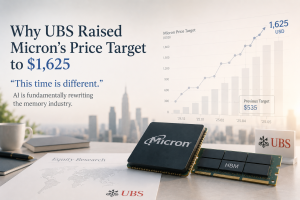
All it took was a price target raise from Timothy Arcuri, a senior semiconductor analyst at UBS. He lifted his target from $535 to $1,625, a 204% increase, nearly tripling it in a single day.
Back in April, DA Davidson had turned heads by initiating coverage with a $1,000 target, bold at the time but framed as a 2030 price target. Then Bank of America came in at $950. Melius Research followed at $1,100. And now UBS is calling for more than 100% upside from current levels.
The Analyst Behind the Call: Wall Street’s #2 Ranked
Timothy Arcuri is UBS’s lead semiconductor analyst. He studied chemical engineering at Villanova University and spent time at SG Cowen, Deutsche Bank, Citi, and Cowen before joining UBS in 2017. He has more than 25 years on Wall Street.
What matters most is his track record. TipRanks currently ranks Arcuri #2 out of 12,268 analysts it monitors, not just in semiconductors but across all sectors and all industries.
His success rate stands at 86%, with an average return of 99.4%. His success rate on Nvidia specifically is 94%. TipRanks calculates these rankings using three factors: hit rate on stock calls, average return, and statistical significance. This is not a one-hit wonder. He has also received the Institutional Investor All-America Research Team award multiple times, voted on by actual buy-side portfolio managers. If Wall Street has a Most Valuable Analyst award, Arcuri has won it more than once.
How Arcuri Got to $1,625
The math starts with an earnings projection. Arcuri expects Micron’s EPS to exceed $100 from 2027 through 2029, with cumulative free cash flow of over $400 billion during that period. He applies a 15x next-twelve-months P/E multiple, in line with AI infrastructure peers, and discounts back one year. That gets you to $1,625.
The core argument is simple: there is no reason Micron should trade at a dramatically different P/E than Nvidia. At the time of the note, Micron was trading in the mid-$700s with a forward P/E of around 8.4x. Nvidia trades at 35 to 40x forward earnings. That gap is the investment thesis.
This is a direct challenge to what has long been the memory industry’s original sin: the cycle. For decades, memory chip companies have been valued as commodities, boom and bust and repeat, priced accordingly with low multiples. Arcuri’s argument is that AI has permanently broken that cycle.
He wants the market to reclassify memory semiconductors. Not as a cyclical commodity business, but as critical infrastructure for the AI era.
The evidence is in the numbers. Micron’s most recent quarterly revenue came in at $23.8 billion, up 196% year over year, the fourth consecutive quarterly revenue record. Its Cloud Memory business unit posted 66% gross margins. And crucially, supply is only meeting 50 to 67% of HBM and DRAM demand.
When supply can’t keep up with demand, pricing power shifts to the producer. In past memory cycles, oversupply repeatedly crushed prices. HBM is different. The design, manufacturing, and packaging all require cutting-edge technology. New production lines take years to build. Supply cannot scale quickly.
Micron has also signed a five-year long-term supply agreement with Nvidia for HBM4, the kind of deal that simply did not exist in the memory industry before. Arcuri believes long-term supply agreements are now becoming the industry standard, with up to 30% of global commodity DRAM volumes potentially locked into multi-year contracts. Trading some near-term revenue for earnings visibility and stability. That is the structural shift he is betting on.
The Analyst Who Called It First, and the Race That Followed
To be fair, Arcuri was not the first to go big on Micron. On April 28, DA Davidson’s Gil Luria initiated coverage with a $1,000 price target, a 2030 target he noted, when Wall Street consensus was still in the $550 to $600 range. The reaction was mixed. Many said he had gotten ahead of himself.
Within a month, other firms pushed their targets into the $950 to $1,100 range. Then Arcuri tripled his in one move. In hindsight, Luria’s $1,000 looks less like an outlier and more like the opening bid.
Arcuri’s own target history on Micron tells its own story:
| Date | Previous Target | New Target | Note |
|---|---|---|---|
| December 2025 (early) | $275 | $295 | |
| December 2025 (late) | $295 | $300 | |
| January 7, 2026 | $300 | $400 | First big jump |
| February 2026 | $400 | $450 | |
| April 2026 | $450 | $535 | |
| May 26, 2026 | $535 | $1,625 | Second big jump |
From $295 at the end of last year to $1,625 today, a 5.5x increase in six months. The stock was consistently outrunning his targets. By April, when he raised to $535, Micron was already trading in the $700s. That is when conviction took over.
Why Micron Matters for Samsung and SK Hynix
The global memory industry has three players that can manufacture HBM at scale: SK Hynix, Samsung Electronics, and Micron. Of the three, Micron is the only one listed in the United States, which means it is the proxy global investors use to gauge the entire sector.
When Wall Street rerates Micron, it is effectively rerating Samsung and SK Hynix at the same time.
By overall DRAM market share in 2025: SK Hynix leads at 36%, Samsung follows at 34%, and Micron sits at 25%. SK Hynix overtook Samsung as the world’s largest DRAM maker for the first time in its history last year. In HBM specifically, SK Hynix dominates with 62% share as of Q2 2025, followed by Micron at 21% and Samsung at 17%.
Micron’s entire 2026 HBM allocation is already sold out. Beyond the five-year Nvidia deal, it has new fabs under construction in Singapore, Taiwan, and New York. SK Hynix has signed a three-year DDR5 long-term supply agreement with Microsoft and is in late-stage negotiations with Google for a five-year HBM and server DRAM deal. Samsung is pursuing similar arrangements with major hyperscalers.
The structural shift Arcuri identified at Micron is not a Micron-only story. As he put it:
“AI has permanently changed the way the memory chip business works.”
Three years ago, in 2023, Micron’s EPS was negative $5.34. The stock was trading in the $50s. Today it crossed $900. If you apply the same valuation logic to SK Hynix and Samsung, the companies that actually lead in HBM market share, investors instinctively start doing the math.
Is the Bull Market Entering Its Final Act?
The target race on Wall Street is heating up. Meanwhile, in Korea, Samsung Electronics and SK Hynix 2x leveraged ETFs launched today, the first single-stock leveraged products ever listed on the Korean market, and retail investors are buzzing.
Howard Marks describes bull markets in three stages. In stage one, only a handful of unusually perceptive investors can see that improvement is coming. In stage two, most people accept that the recovery is real. In stage three, everyone becomes convinced that prices will rise forever.
Right now, analyst price targets on Wall Street can’t keep pace with actual stock prices. These targets are supposed to reflect where a stock will be in twelve months. Instead, stocks are blowing past targets within weeks. That is not stage two behavior. That is stage three.
You can’t rush into a single-stock leveraged ETF unless you’re convinced the rally will continue. You know that losses will be doubled on the way down. But the thought of capturing gains at 2x speed pulls people in like moths to a flame.
That said, I want to be careful here. I am not calling a top. I am not telling anyone to sell. What I am saying is this: if you are not a seasoned investor, and you open your portfolio and feel genuinely invincible, that feeling itself is worth paying attention to.
Arcuri’s entire thesis depends on the assumption that Micron’s earnings hold through 2029. The global memory industry has never once escaped its boom-bust cycle. The three biggest memory companies in the world will need to finally break that curse before the ceiling truly comes off.
On the morning of May 27, Micron touched $985 intraday before quickly giving back those gains, falling back through $900 and reversing into the $890s. If you were caught up in the excitement and bought at $980, you were already down 10% within hours. Was $985 the all-time high? Nobody knows.
The hardest thing about a bull market is staying balanced between greed and discipline. Bull markets get louder and more irrational as they age. We are watching that happen in real time.
Today in Korea, the KOSPI rose 2.25%, but only 75 stocks advanced while 826 declined. The index says bull market. Most stocks are telling a different story.
I have been a bull for a long time. I wanted this rally more than most. I just did not expect it to arrive like this.
I do not want to deny this bull market. If anything, I want it to last. I want the warmth to spread beyond the two or three dominant names, into the broader market, into a genuine full-market rerating that gives Korean equities a completely different identity.
The party is still going strong.